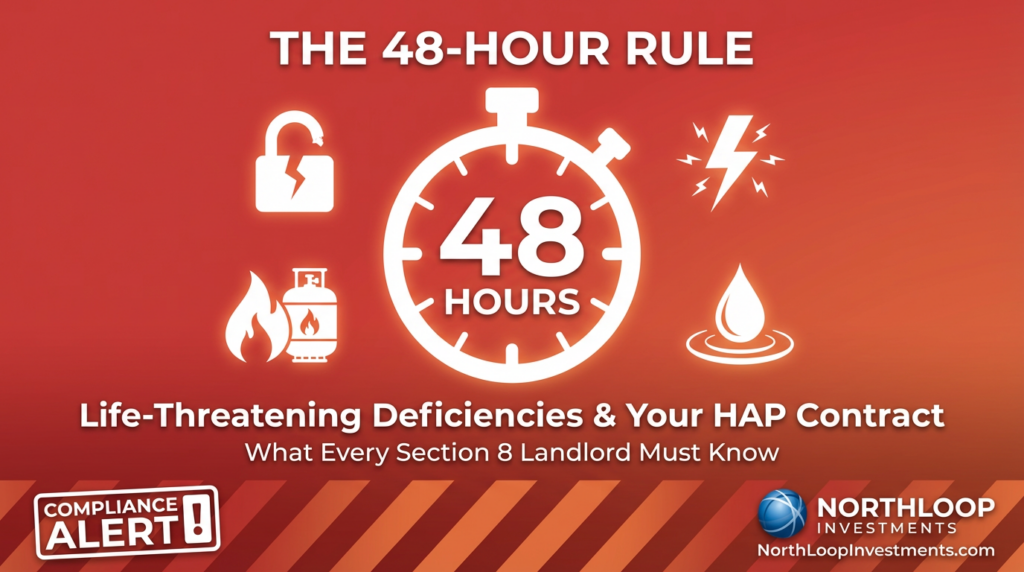

One phone call. 48 hours. Your HAP contract on the line.
If you operate Section 8 properties, you need to understand the 48-hour rule for life-threatening deficiencies. Failure to comply can result in HAP contract termination, loss of rental income, and potential legal liability.
This isn’t a guideline—it’s a hard deadline with serious consequences.
What Are Life-Threatening Deficiencies?
Under HUD’s Housing Quality Standards (HQS) and the newer NSPIRE inspection protocol, life-threatening deficiencies are conditions that pose an immediate danger to tenant health or safety.
The four most common categories:
1. Security Issues
- No working locks on entry doors
- Broken windows on ground floor
- Inoperable security lighting in common areas
2. Electrical Hazards
- Exposed wiring
- Non-functional circuit breakers
- Missing electrical panel covers
- Outlets near water without GFCI protection
3. Fire/Gas Safety
- Gas leaks
- Non-functional smoke detectors or carbon monoxide alarms
- Blocked or inoperable fire exits
- Missing fire extinguishers (in common areas)
4. Essential Utilities
- No heat in winter months
- No hot water
- Non-functional toilets (if only one in unit)
- Sewage backups
The 48-Hour Timeline
Here’s exactly what happens after a life-threatening deficiency is reported:
Hour 0 – Report Received:
- Tenant or PHA inspector reports the issue
- PHA notifies you via phone, email, or portal
- Your responsibility begins immediately
Hour 1–24 – Emergency Response:
- Assess the issue (in-person or via trusted vendor)
- Initiate repairs or temporary mitigation
- Document your response (photos, work orders, vendor contacts)
- Communicate status updates to PHA
Hour 24–48 – Completion & Verification:
- Complete repairs
- Document completion (photos, receipts, work orders)
- Notify PHA of resolution
- Schedule re-inspection if required
Hour 48+ – Deadline Passed:
- Failure to repair = HAP contract abatement or termination
- Loss of rental subsidy payments
- Potential tenant relocation costs
- Damage to your relationship with the PHA
Real-World Example: The $18,000 Mistake
The Scenario:
A landlord in Illinois receives a call on Friday afternoon: a tenant reports no heat, and outside temperature is 28°F.
The Wrong Response:
“I’ll send someone out Monday morning.” (72+ hours)
The Outcome:
- PHA abates the HAP contract on Saturday
- Landlord loses 2 weeks of rental subsidy = $600
- Tenant withholds their portion of rent = $300
- Emergency weekend service call costs $450 (vs. $180 on Monday)
- PHA flags the landlord for future scrutiny
- Total cost: $1,350 + damaged reputation
The Right Response:
“I’ll have an HVAC tech there within 4 hours, and I’ll provide space heaters tonight if needed.”
The Outcome:
- Temporary heat provided within 3 hours
- HVAC repaired within 24 hours
- PHA notified and satisfied
- Tenant retained, relationship maintained
- Total cost: $220 (service call) + $0 lost rent
How to Prepare NOW
1. Build Your Emergency Vendor List
Create a contact sheet with:
- 24/7 HVAC service
- Emergency plumber
- Electrician (licensed, available nights/weekends)
- Locksmith
- Glass/window repair
- General handyman
Pro Tip: Pre-negotiate after-hours rates and response times. A 4-hour response guarantee is worth paying a premium.
2. Create a Life-Threatening Deficiency Protocol
Written policy for your team (or yourself):
- Step 1: Acknowledge report within 1 hour
- Step 2: Assess on-site within 4 hours (or dispatch vendor)
- Step 3: Provide temporary mitigation if repair will take >24 hours
- Step 4: Document everything (photos, timestamps, vendor receipts)
- Step 5: Notify PHA of resolution with proof
3. Conduct Preventive Maintenance
The best way to avoid 48-hour emergencies is to prevent them:
Monthly Walkthroughs:
- Test smoke/CO detectors
- Check HVAC functionality
- Inspect locks and security lighting
- Look for electrical hazards
Seasonal Prep:
- Winterize units (heat, pipes, insulation)
- Summer AC checks
- Storm prep (windows, drainage, roof)
4. Document EVERYTHING
If you’re ever challenged by the PHA, your documentation is your defense:
- Time-stamped photos (before, during, after repairs)
- Vendor work orders with completion dates
- Communication logs (PHA notifications, tenant updates)
- Receipts and invoices
Store digitally (Google Drive, Dropbox, or property management software) for easy access during audits or disputes.
What Happens If You Miss the Deadline?
Short-term consequences:
- HAP contract abatement (loss of subsidy payments)
- Tenant may withhold rent or request emergency transfer
- Strained PHA relationship
Long-term consequences:
- Flagged for increased inspection frequency
- Difficulty securing future HAP contracts
- Potential lease termination and unit vacancy
- Legal liability if tenant injury occurs
The bottom line: Missing the 48-hour deadline costs you money, reputation, and future opportunities.
Looking to Exit Your Portfolio?
If you own multifamily apartment buildings or HUD Senior/Family Housing and are exploring an exit or partnership, we provide all-cash offers with no broker commissions paid by the seller* and closing dates that work around your schedule.
Visit NorthLoopInvestments.com or send me a message to start a confidential conversation.
Disclaimer: This newsletter is provided for informational and educational purposes only and does not constitute legal, tax, or compliance advice. HUD and PHA policies may vary by jurisdiction. Consult with legal counsel and your local PHA for specific guidance. *Broker commissions may apply in Illinois where a principal is a licensed real estate broker.
#affordablehousing #section8housing #HUDproperties #HAPcontracts #multifamilyinvestors