When you’re ready to exit your affordable housing portfolio, you face a critical decision: list with a broker or pursue a direct sale?
Both paths have merit. The right choice depends on your timeline, financial goals, property condition, and tolerance for complexity.
This newsletter breaks down the real-world differences—timelines, costs, buyer dynamics, and strategic fit—so you can make an informed decision.
Path 1: Brokered Sale (Traditional Listing)
How It Works:
- You hire a commercial real estate broker to list your property on the open market
- Broker markets to their network, online platforms (LoopNet, CoStar), and direct outreach
- Multiple buyers submit offers
- You select the best offer and proceed through due diligence
- Close after 60–120 days (or longer)
Pros:
✅ Maximum Market Exposure
Your property is visible to hundreds or thousands of potential buyers, increasing the likelihood of competitive bidding.
✅ Potentially Higher Sale Price
Competition among buyers can drive up offers, especially for well-maintained, high-performing assets.
✅ Broker Expertise
Experienced brokers handle marketing, negotiations, and buyer vetting, reducing your workload.
✅ Third-Party Validation
A broker-led process signals to buyers that the deal is legitimate and professionally managed.
Cons:
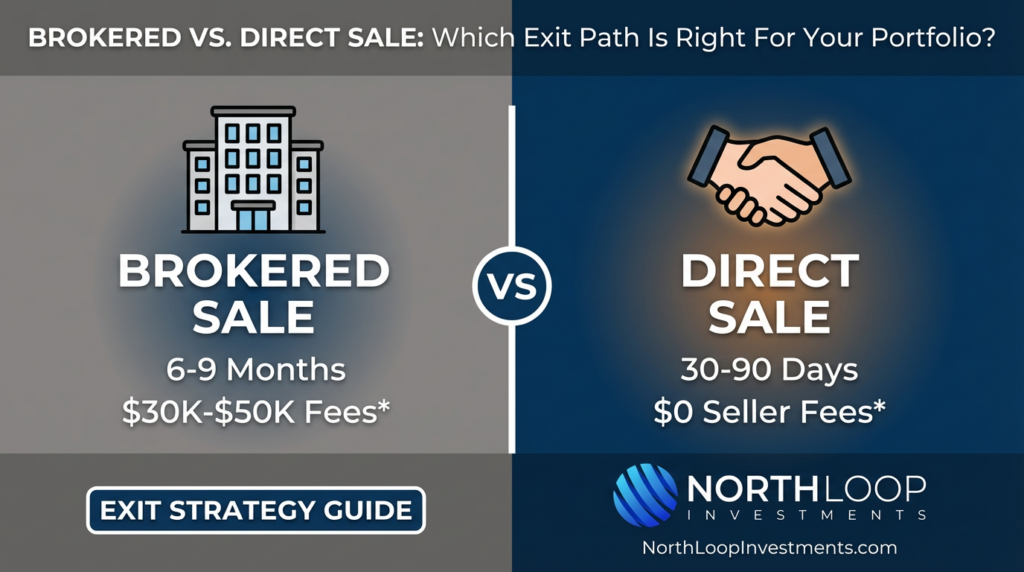
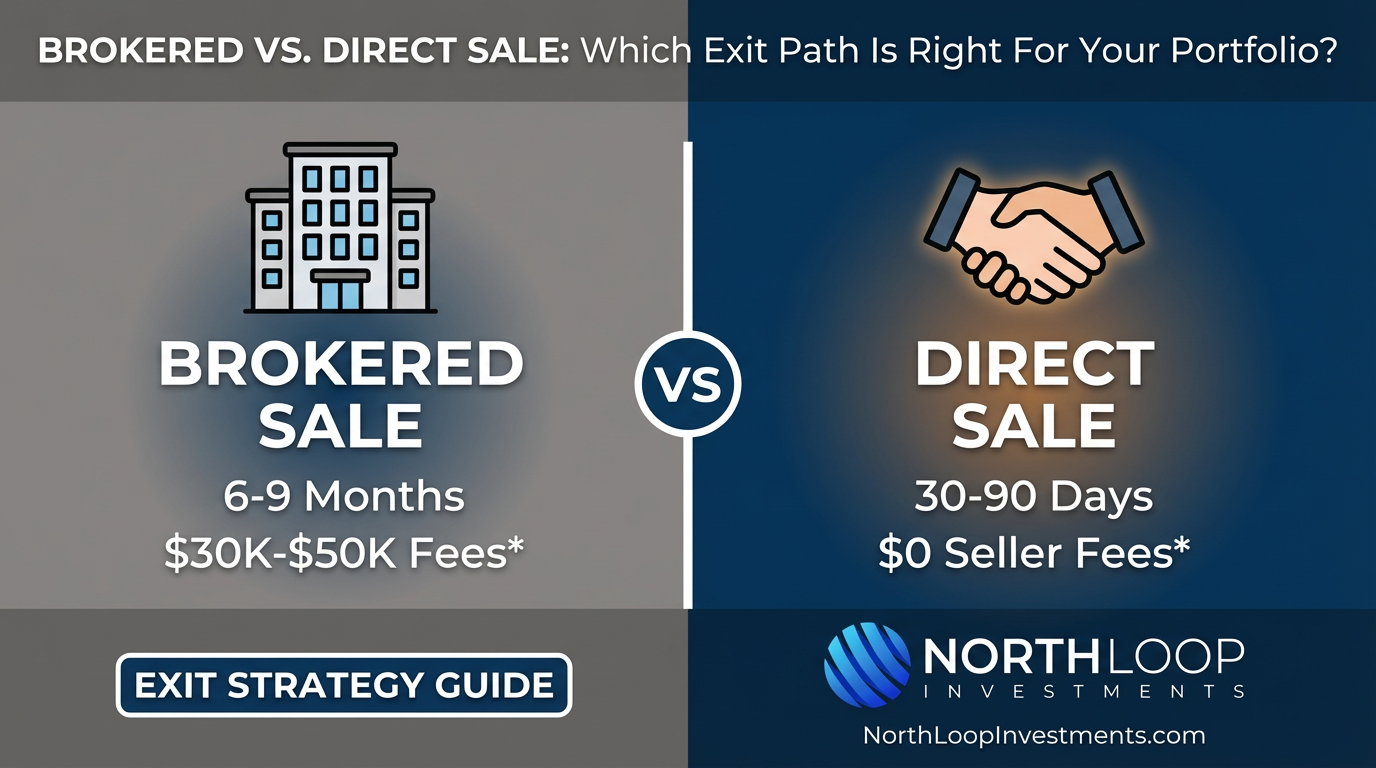
❌ 6–9 Month Timeline (Average)
From listing to closing, expect:
- Month 1: Prep and launch listing
- Months 2–3: Marketing, showings, offer collection
- Months 4–5: Negotiations and due diligence
- Months 6–9: Closing (with potential delays)
❌ 5–6% Commission Fees (Typical)
On a $2M sale, that’s $100,000–$120,000 in broker fees (split between listing and buyer agents).
Note: In some states/markets, seller pays the full commission; in others, it’s negotiable.
❌ Public Exposure
Your property, financials, and operations are visible to competitors, tenants, and the market. This can create:
- Tenant anxiety or turnover
- Competitor intelligence gathering
- Loss of privacy
❌ Multiple Buyer Interactions
Showings, due diligence requests, and negotiations with multiple parties can be time-consuming and disruptive to operations.
Best For:
- Owners with 6–12 months to wait for the right buyer
- Well-maintained, high-performing assets in strong markets
- Sellers prioritizing maximum sale price over speed or privacy
- Properties with broad buyer appeal (market-rate or mixed-income)
Path 2: Direct Sale (Off-Market Transaction)
How It Works:
- You identify or are approached by a direct buyer (investor, operator, or acquisition firm)
- Buyer reviews your property data privately
- Buyer submits an all-cash or favorable-terms offer
- You negotiate directly (no broker intermediary)
- Close in 30–90 days (sometimes faster)
Pros:
✅ 30–90 Day Timeline
Direct buyers often have:
- Pre-approved financing (or all-cash capability)
- In-house due diligence teams
- Streamlined closing processes
✅ $0 Seller Commission (Typical)
You keep 100% of the sale price.*
*Exception: In Illinois and certain jurisdictions, broker commissions may apply depending on transaction structure and licensing.
✅ Privacy & Discretion
Your sale remains off-market:
- No public listings
- No tenant disruption
- No competitor visibility
✅ One Buyer, One Negotiation
Simpler process with fewer parties, less back-and-forth, and reduced stress.
✅ Flexible Closing Terms
Direct buyers often accommodate:
- Seller-friendly closing dates
- Lease-back arrangements
- Partial equity retention (if you want to stay involved)
Cons:
❌ Potentially Lower Sale Price
Without competitive bidding, you may leave 5–15% on the table compared to a fully marketed sale.
❌ Limited Buyer Pool
You’re negotiating with one (or a few) buyers, not the entire market.
❌ Buyer Vetting Risk
Without a broker, you’re responsible for vetting the buyer’s credibility, financial capacity, and track record.
Best For:
- Owners who need to exit quickly (estate settlements, health issues, partnership disputes)
- Properties requiring privacy (troubled assets, sensitive tenant situations)
- Sellers prioritizing certainty and speed over maximum price
- Owners of HUD/Section 8 properties seeking buyers with affordable housing experience
Side-by-Side Comparison
| Factor | Brokered Sale | Direct Sale |
|---|---|---|
| Timeline | 6–9 months | 30–90 days |
| Seller Commission | $30K–$50K (5-6%)* | $0* |
| Market Exposure | Public, broad | Private, targeted |
| Buyer Pool | Multiple (competitive) | Single (or few) |
| Sale Price | Potentially higher | Potentially lower (5-15%) |
| Privacy | Low (public listing) | High (off-market) |
| Closing Flexibility | Moderate | High |
| Best For | Maximize price | Maximize speed & certainty |
*Commission structures vary by state and transaction. In Illinois, broker commissions may apply in certain circumstances.
Hybrid Strategy: Test the Market First
Some sellers use a 90-day hybrid approach:
Step 1: List with a broker for 90 days
- If you receive a strong offer (at or above asking), proceed
- If offers are weak or slow, pivot to direct sale
Step 2: Pursue direct sale after 90 days
- Re-engage with direct buyers you met during the listing period
- Negotiate off-market with known buyers
Benefit: You capture market exposure while retaining the option to exit quickly.
Which Path Is Right for You?
Ask yourself:
1. What’s your timeline?
- 6+ months available → Brokered sale
- Need to close in 90 days → Direct sale
2. What’s your priority?
- Maximum sale price → Brokered sale
- Speed and certainty → Direct sale
3. How important is privacy?
- Public exposure acceptable → Brokered sale
- Discretion critical → Direct sale
4. What’s your property condition?
- Well-maintained, high-performing → Brokered sale (competitive bidding)
- Deferred maintenance, operational challenges → Direct sale (experienced affordable housing buyer)
Looking to Exit Your Portfolio?
If you own multifamily apartment buildings or HUD Senior/Family Housing and are exploring an exit or partnership, we provide all-cash offers with no broker commissions paid by the seller* and closing dates that work around your schedule.
Visit NorthLoopInvestments.com or send me a message to start a confidential conversation.
Disclaimer: This newsletter is provided for informational and educational purposes only and does not constitute legal, financial, or real estate advice. Commission structures and transaction timelines vary by market, property type, and jurisdiction. Consult with legal and financial advisors before making exit decisions. *Broker commissions may apply in Illinois where a principal is a licensed real estate broker.
#affordablehousing #section8housing #HUDproperties #HAPcontracts #multifamilyinvestors